A sleep app can count hours, a fitness platform can record steps, and an AI assistant can help make sense of notes and health documents. All three may appear in the same “health and wellness” category, yet they solve different problems. Choosing the wrong type of app often leads to disappointment, not because the software is poor, but because it was designed for a different job. A clearer overview of these categories is available at https://www.holivita.ai/blog/tracker-coach-or-translator-a-guide-to-the-types-of-wellness-apps-available.
The easiest way to understand the difference is to look at the question each type of tool is built to answer. A tracker asks what happened. A coach focuses on what the user should try to do next. An AI health assistant is more concerned with what the available information may mean and how it can be organized. None of these roles automatically replaces the others, and an app that performs one of them well may be quite limited in the rest.
Trackers are strongest at measuring and recording
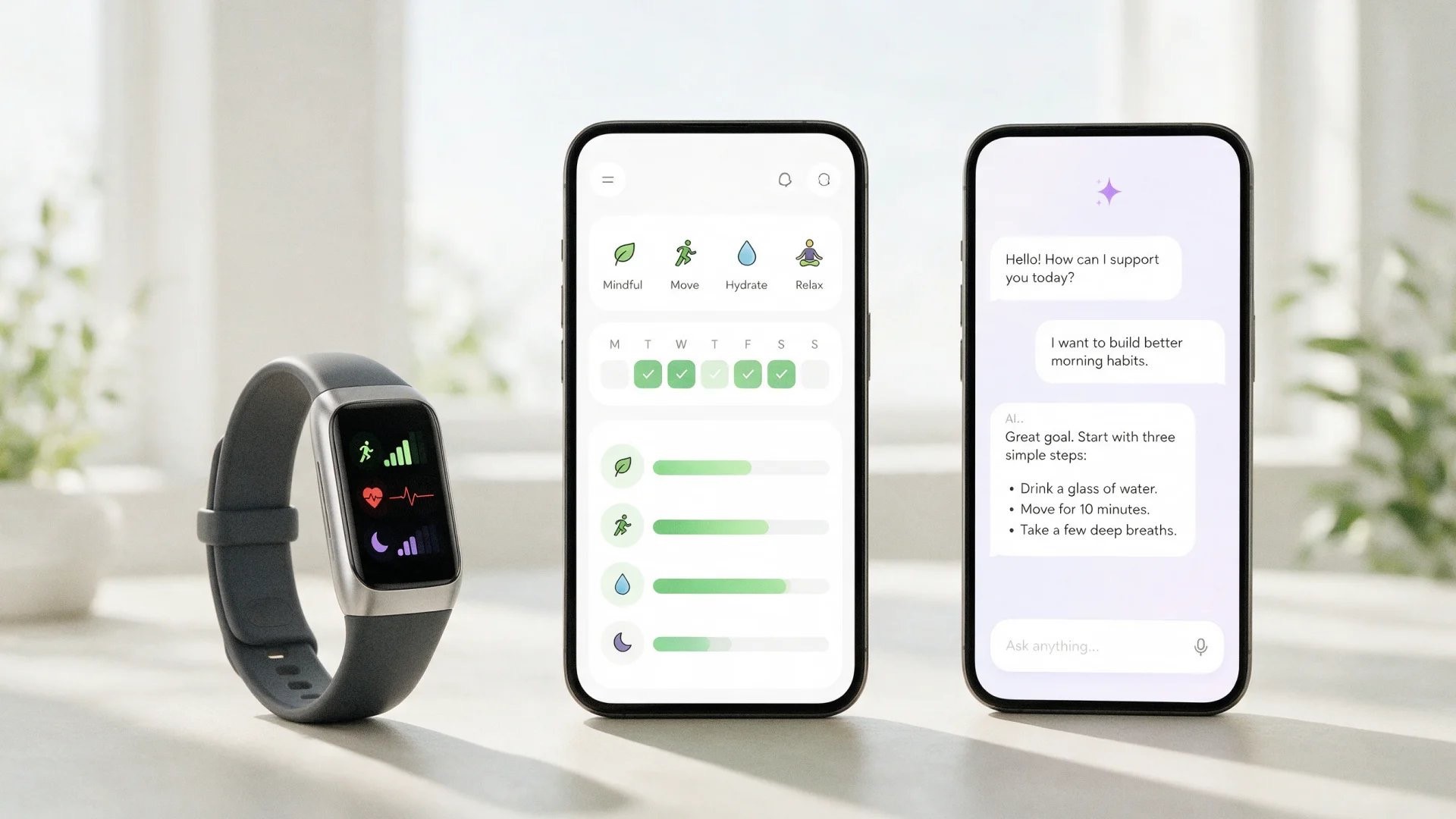
Health trackers are built around data collection. They count steps, record workouts, estimate sleep duration, log weight or store information entered manually. Wearable devices extend this model by collecting measurements without requiring the user to type them in several times a day.
The strength of a tracker is consistency. A person may not remember how many nights they slept poorly last month, but an app can preserve a record. The same applies to walking distance, resting heart rate or the frequency of exercise sessions. Trends become easier to see because the information is stored in a comparable format.
That does not mean every measurement has medical significance. Consumer devices can provide useful estimates, but their readings should not automatically be treated as clinical findings. Accuracy differs by device and by the type of measurement. Even a perfectly recorded number may require context before it becomes useful.
Tracking can also create more data than insight. A dashboard may show dozens of graphs while leaving the user unsure what to do with them. Knowing that sleep averaged six hours and forty minutes is different from understanding why sleep changed or whether that pattern matters. This is where the limits of a pure tracker become visible.
For people who mainly want to monitor habits or observe changes over time, that limitation may not be a problem. A simple record can be exactly what is needed.
Wellness coaches focus on behaviour
A coaching app usually starts from a different assumption. The user does not simply want to know what happened. They want help changing a habit. The software may suggest goals, send reminders, create routines or encourage gradual progress.
This approach is common in fitness, nutrition, meditation and sleep applications. Instead of presenting only a graph, a coach may suggest going to bed at a more consistent time, taking a short walk or completing a breathing exercise. The design often relies on prompts, streaks and progress indicators to keep the user engaged.
A wellness coach can be useful when the target behaviour is already clear. Someone who wants to walk more may benefit from reminders and realistic weekly goals. A person trying to establish a regular sleep schedule may find a structured evening routine helpful. The app does not need to solve a diagnostic problem to support those changes.
The weakness appears when a symptom or health concern does not fit the coaching model. Persistent fatigue, unexplained pain or a new medication side effect cannot safely be reduced to a motivational challenge. Telling someone to improve their routine is not the same as evaluating why they feel unwell.
Good coaching tools stay within that boundary. They support behaviour without presenting lifestyle advice as a substitute for medical assessment.
AI assistants work with context and explanation
An AI health assistant occupies another part of the spectrum. Its value is less about counting and more about interpreting information supplied by the user. It can help summarize medical documents, organize notes, explain terminology and connect related entries across a longer period.
That makes context important. A single note saying “low energy” is not very informative. A sequence showing low energy after several nights of poor sleep, together with a medication change and a recent test result, creates a more complete picture. AI can help organize that picture without claiming to know the diagnosis.
This type of tool can also be useful before a medical appointment. A person may have several weeks of notes and multiple documents but only a few minutes to explain the problem. An assistant can help reduce that material to a clear timeline and identify questions the user may want to ask.
Typical tasks for an AI health assistant can include:
- summarizing personal health notes
- explaining unfamiliar terms in reports
- organizing symptoms by date or theme
- comparing information recorded at different times
- preparing a concise overview before an appointment
- helping formulate questions for a healthcare professional
These functions overlap partly with trackers and coaches, but the emphasis is different. The assistant is working with meaning and context rather than simply measurement or motivation.
Medical portals belong to another category
Patient portals are sometimes grouped together with wellness apps, although their purpose is different. A hospital or clinic portal is primarily an access point to formal healthcare information. It may contain test results, appointment details, prescriptions, messages from clinicians and medical records.
Its strength is authority. The information comes directly from the healthcare system rather than from a consumer device or manually entered note. If a laboratory test was performed, the portal may show the official result exactly as it appears in the medical record.
The limitation is that portals are often designed around the healthcare provider rather than the patient’s complete health story. Information may be split between different clinics or systems. Personal observations made between appointments may have no place in the record. A portal can therefore be excellent at storing formal medical data while remaining less useful for combining that data with everyday notes.
This is why different digital health tools can complement one another. A portal stores official records, a tracker records measurements, a coach supports behaviour and an AI assistant helps organize and understand information across sources.
Choose the tool by starting with the problem
The most useful question is not which health app has the longest feature list. It is what the user is actually trying to accomplish. If the goal is to count steps, a sophisticated AI assistant may be unnecessary. If the problem is making sense of several months of notes and reports, a simple step counter will not help.
The same principle prevents unrealistic expectations. A wellness coach should not be expected to diagnose unexplained symptoms. A tracker should not be judged for failing to explain a laboratory result. An AI assistant should not be treated as a clinician simply because it can discuss medical terminology.
Privacy should also influence the choice. Health information can be sensitive, and users should understand what an app stores, how the information is protected, whether data is shared with third parties and whether it can be exported or deleted. The more personal information a tool collects, the more important those questions become.
It is also worth considering whether the app can remain useful after the first week. A tool that demands constant manual input may become difficult to maintain. Another may collect large amounts of information without helping the user do anything meaningful with it. Features matter only when they match a real task.
The best health app is therefore not a universal category. A tracker, coach, medical portal and AI assistant each solve a different part of the problem. Knowing that difference makes it easier to choose software for what it actually does rather than for how broadly it is marketed.